Grundrisse by Karl Marx
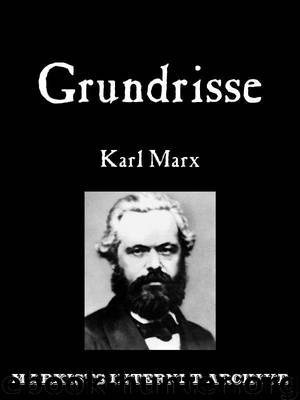
Author:Karl Marx
Language: eng
Format: mobi
Publisher: Marxists Internet Archive
Published: 2014-03-23T16:21:27.567335+00:00
Exchange of labour for labour rests on the worker's propertylessness
<But one more remark on the topic above: The exchange of equivalents, which seems to presuppose ownership of the products of one's own labour -- hence seems to posit as identical: appropriation through labour, the real economic process of making something one's own [Zueigen-Machen], and ownership of objectified labour; what appeared previously as a real process is here recognized as a legal relation, i.e. as a general condition of production, and therefore recognized by law, posited as an expression of the general will -- turns into, reveals itself through a necessary dialectic as absolute divorce of labour and property, and appropriation of alien labour without exchange, without equivalent. Production based on exchange value, on whose surface this free and equal exchange of equivalents proceeds, is at its base the exchange of objectified labour as exchange value for living labour as use value, or, to express this in another way, the relating of labour to its objective conditions -- and hence to the objectivity created by itself -- as alien property: alienation [Entäusserung] of labour. At the same time, the condition of exchange value is its measurement by labour time, and hence living labour -- not its value -- as measure of values. The notion that production and hence society depended in all states of production on the exchange of mere labour for labour is a delusion. In the various forms in which labour relates to the conditions of production as its own property, the reproduction of the worker is by no means posited through mere labour, for his property relation is not the result but the presupposition of his labour. In landed property this is clear; it must also become clear in the guild system that the particular kind of property which labour creates does not rest on labour alone or on the exchange of labour, but on an objective connection between the worker and a community and conditions which are there before him, which he takes as his basis. These too are products of labour, of the labour of world history; of the labour of the community -- of its historic development, which does not proceed from the labour of individuals nor from the exchange of their labours. Therefore, mere labour is also not the presupposition of realization [Verwertung]. A situation in which labour is merely exchanged for labour -- whether in the direct, living form, or in the form of the product -- presupposes the separation of labour from its original intertwinement with its objective conditions, which is why it appears as mere labour on one side, while on the other side its product, as objectified labour, has an entirely independent existence as value opposite it. The exchange of labour for labour -- seemingly the condition of the worker's property -- rests on the foundation of the worker's propertylessness.>
(It will be shown later that the most extreme form of alienation, wherein labour appears in the relation of capital and
Download
This site does not store any files on its server. We only index and link to content provided by other sites. Please contact the content providers to delete copyright contents if any and email us, we'll remove relevant links or contents immediately.
| Anarchism | Communism & Socialism |
| Conservatism & Liberalism | Democracy |
| Fascism | Libertarianism |
| Nationalism | Radicalism |
| Utopian |
The Secret History by Donna Tartt(19027)
The Social Justice Warrior Handbook by Lisa De Pasquale(12182)
Thirteen Reasons Why by Jay Asher(8883)
This Is How You Lose Her by Junot Diaz(6872)
Weapons of Math Destruction by Cathy O'Neil(6260)
Zero to One by Peter Thiel(5782)
Beartown by Fredrik Backman(5734)
The Myth of the Strong Leader by Archie Brown(5491)
The Fire Next Time by James Baldwin(5423)
How Democracies Die by Steven Levitsky & Daniel Ziblatt(5211)
Promise Me, Dad by Joe Biden(5139)
Stone's Rules by Roger Stone(5078)
A Higher Loyalty: Truth, Lies, and Leadership by James Comey(4946)
100 Deadly Skills by Clint Emerson(4911)
Rise and Kill First by Ronen Bergman(4775)
Secrecy World by Jake Bernstein(4738)
The David Icke Guide to the Global Conspiracy (and how to end it) by David Icke(4696)
The Farm by Tom Rob Smith(4500)
The Doomsday Machine by Daniel Ellsberg(4481)
